
When you’re having a rough day, the last thing I’d suggest is that you pretend you’re fine by making it aesthetic, write in your journal until you achieve inner peace, or manifest a calm nervous system.
Sometimes, it’s just about surviving the next 10 minutes without a wobble. Like when you’re standing in the kitchen staring at the sink, or you’ve crawled back into bed ‘for a second’, and suddenly it’s 2 p.m.

That’s what emergency self-care is really about. Forget a full blown spa day, or a pampering session at home with trendy soy candles and a curated playlist. You just want to take the edge off with a few bite-sized, yet practical, self-care activities you can do right now.
When my anxiety is at its worst, I just need quick, non-gimmicky ways to stop my brain from highlighting and obsessing over a painful moment of the day.
For me, a personal remark or negative social media comment can easily start a spiral. As if my brain freezes and descends into a feedback loop. At those times, I need a strategy to snap out of it gently, realistically, without toxic positivity and pretending everything is now fine.
The goal is a small shift, not a new life. With that, the following 10 tiny things should be useful for those bad days. Particularly when feeling overstimulated, exhausted, and having had enough of everyone’s shenanigans.
Pick one or two things that will help you think more clearly.
Quick note: if you feel unsafe, please reach out to local emergency services or a crisis line in your country.
How to feel better on a bad day (without fixing your whole life)
On a really bad day, feeling better might mean something like unclogging your mind, calming your body, or regaining a sense of control.
For this, you want to reach for something that matches what’s happening right now. If your body feels tight and tense, muscle release and breathing exercises are a good start. Likewise, if your mind is endlessly going over stuff in a loop, try a quick brain dump or grounding exercise.
If everything feels pointless and messy, do a ‘get my life together’ activity that establishes some structure.
What emergency self-care looks like in real life (quick examples)
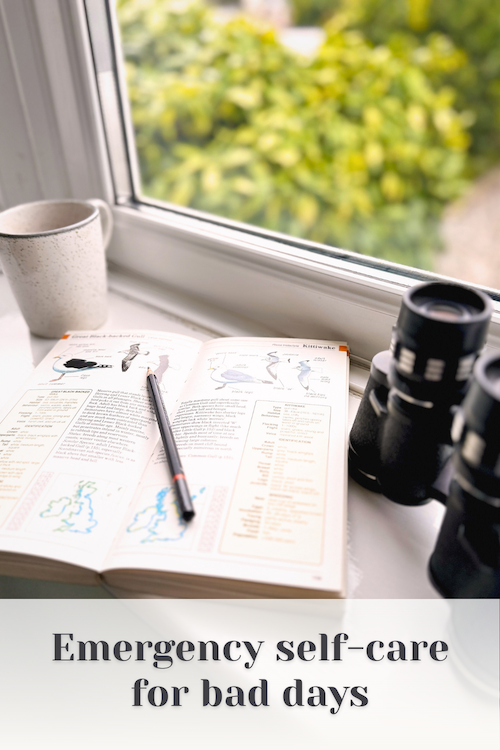
You might view emergency self-care as first aid.
When you catch yourself thinking: Okay. I’m not thriving here. What are some small things that could make the next 10 minutes easier?
For me, to snap my mind out of a spiral after reading negativity or seeing toxic chatter online, I might grab my binoculars and do a quick birdwatching session or text someone close.
You could try sitting on the floor, your back against the couch, and doing just one deep exhale. Or put your phone face down and step into another, quieter room.
Leading health organizations often suggest grounding techniques (like the 5-4-3-2-1 method), as they can help you pull back to the present by tapping into your senses.
As you can see, this doesn’t have to be fancy. You can choose to take care of yourself in a way that actually fits the day you’re having.
Here’s how to decide which one to choose. If you’re stressed, start with the body tools. When your mind is racing, writing or grounding can help.
1) The 60-second exhale reset
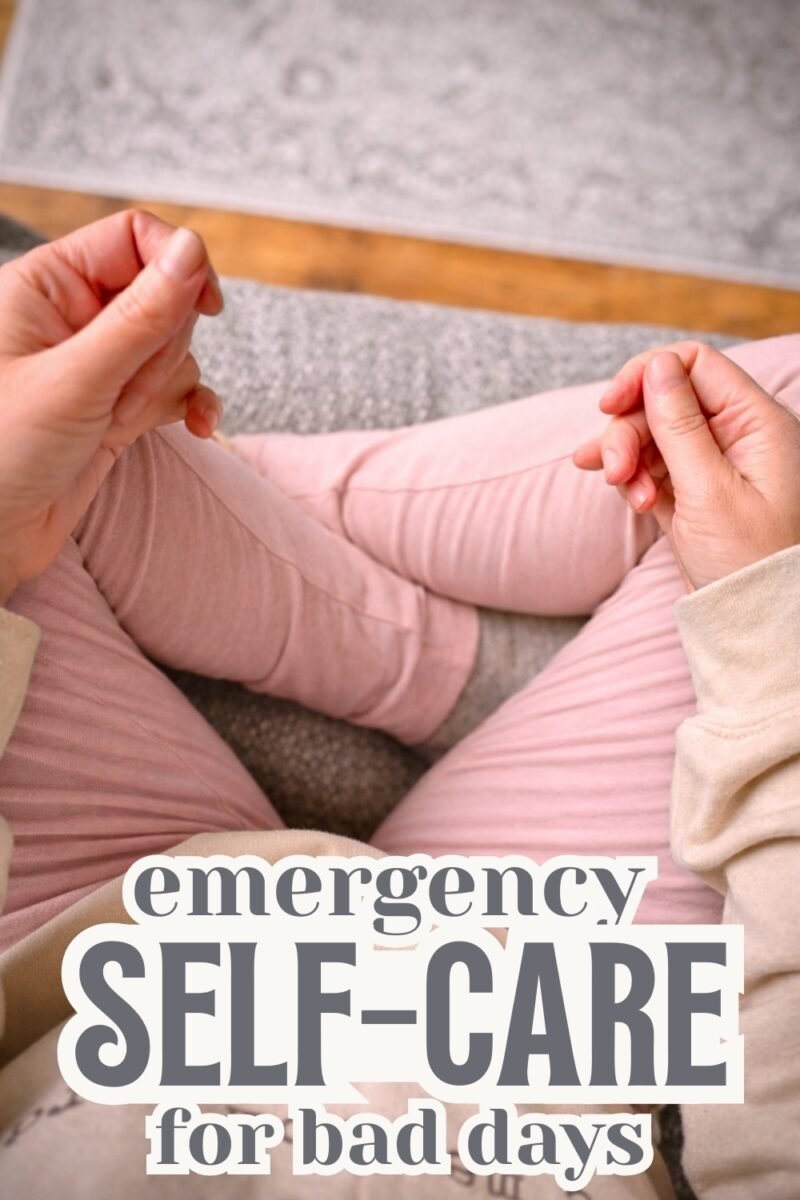
Ideal for when you feel a bit panicky for no apparent reason.
The American Psychological Association notes that slowing your breath is a great way to help your body shift out of stress and back to its more natural state.
In its most basic form, find yourself a calm and comfortable space and inhale normally through your nose, then exhale a little longer than you inhale. 5 slow breaths should do the trick. If you prefer counting, inhale for 4 seconds and exhale for 6.
I usually do this with one hand on my chest because it stops me from rushing it.
The reason this works is that longer exhales force your body out of high alert mode into a calmer state. And that can be enough to take the edge off the shaky feeling and racing heart super quickly.
2) Name five things grounding trick
Helpful when you feel scattered and your mind just needs to take a breather.
You can do this quietly anywhere: name 5 things you can see, 4 things you can feel, 3 things you can hear, 2 things you can smell, and 1 thing you can taste.
It really helps to interrupt racing thoughts by giving your mind something else to focus on.
Best of all, this mindfulness technique doesn’t even require you to leave the room. Just one easy trick to staying in the present instead of spiraling backward.
For the quick version, use the 3-3-3 rule. Name 3 things you can see, 3 sounds you can hear, then move 3 body parts (tap fingers, roll shoulders, and wiggle toes).
Cleveland Clinic recommends this is a simple grounding strategy that uses your senses to bring you back to the present moment.
3) The self-compassion sentence
For when your inner critic is being extra mean and you want to silence it gently.
When you’re feeling down, that inner voice can get pretty vicious fast.
Try a phrase like: “This sucks, and I’m doing the best I can with the resources I have right now.”
That’s practicing self-love while recognizing that you’re not actually okay. This way, you avoid piling shame on top of a day that already hurts.
4) Text a safe person with a clear ask
You’re in your feels and need someone to reality check your brain for a minute.
On bad days, your brain will insist you’re a burden. But that’s not true.
Message a bestie stating: “Bad brain day. Could you tell me what’s real?” or: “No advice. Just some reassurance.”
If no one is around, draft it in notes as if someone who understands will see it. It might not look like much, but reaching out to others is one of the quickest ways to stop deeping it.
5) Change your sensory input
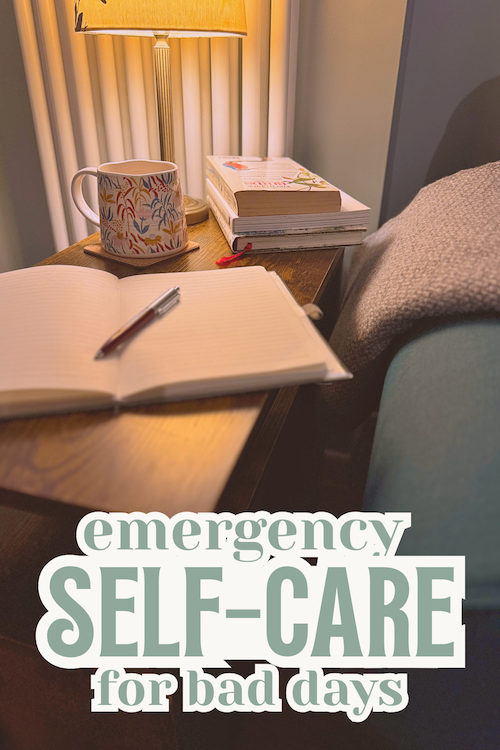
An effective method when you feel overstimulated, and the world has turned up the volume and brightness to the max.
On bad days, a lot can be going on: from loud noises and harsh screens, to just too many tabs open, literally and metaphorically.
Choose one thing to turn down for 10 minutes. Some ideas could be going into a quiet room, dimming the lights, finding a calm playlist, or throwing on a hoodie for an extra layer of coziness.
6) The shoulders-and-jaw release
You know it: body is low-key clenched, and you didn’t even realize you were holding tension everywhere.
Here’s a quick exercise you can do in 20 seconds tops. Just lift your shoulders right up to your ears and tense for 5 seconds. Then drop them suddenly as you exhale. Do it once.
Next, unclench your jaw and let your tongue soften.
The reason this works is that your brain usually calms down when your muscles relax. After all, stress and tension go hand in hand.
And it’s a super quick way to take the edge off, making everything just a tad easier to handle.
7) Warm hands, cool face, or a comfort object
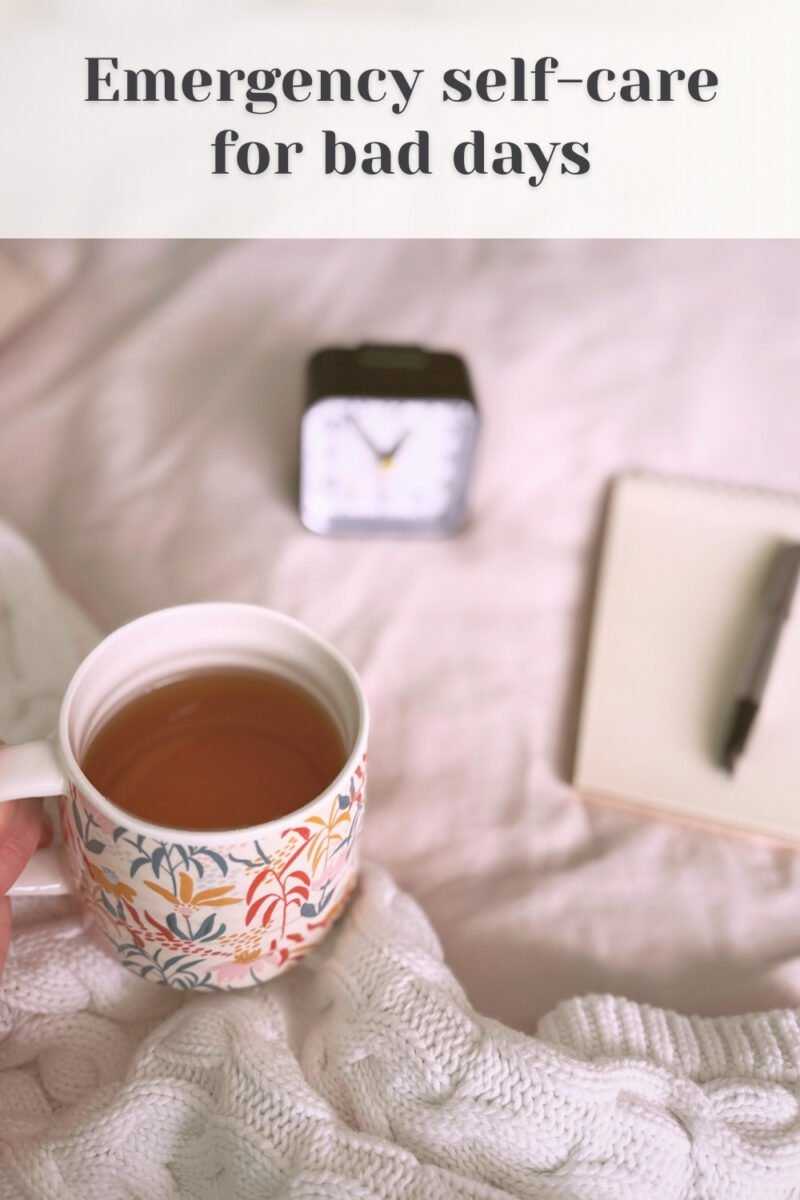
Perfect for days when you’re not in the mood to do anything “productive,” but you can handle two minutes of comfort that actually helps.
You already know this if you live with chronic illness or pain: you do a lot of coping in your head and accept what you can’t change. But the quick comfort still counts.
I often reach for a bowl of warm water to soak my hands for 3-5 minutes when they feel stiff. But even if you don’t have such health issues, you probably experience cramps, headaches, too much screen or muscle tightness.
Other things you might try:
- Hold a warm mug between both hands.
- Put a heating pad on whatever hurts.
- Put a cool cloth on your face, you get the idea.
It’s okay to want to need comfort. You’re human.
8) The 5-minute brain dump
This one’s for when your thoughts won’t stop looping, and you need to get them out of your head.
Set a 5-minute timer and write it all down in its messy truth. No need for order or spelling correctly.
Below that, write: The next kind step is _.
The aim is to silence the incessant replay of thoughts in your head and not necessarily to create a journaling habit. That could also be a good thing.
9) One tiny “get my life together” task
Great for when everything feels messy and out of control, and you need one quick win to steady yourself.
When you feel stuck and helpless, do a small task with an immediately visible result.
This could be something like putting the dishes in the sink, starting the laundry, clearing one surface, or tidying your bag.
There’s no quicker way to feel in control again than seeing the before and after difference.
It’s a small but clear signal to your brain that you can still make changes to your environment. You don’t need a huge transformation to get your life in order.
Doing these tiny daily habits over time builds wellness, but right now they function as our emotional quick fixes.
10) Close the loop on the trigger
Best for when you can’t stop rereading or re-living online negativity, and you need a clean boundary so your nervous system can finally relax.
If you’re being tormented by a comment or DM, your brain just wants to fix it by replaying it endlessly. So let’s give it a container.
First of all, you want to minimize re-exposure. I know if I keep reopening the app “just to check,” I’m basically poking at the bruise. It’s way kinder to close it for 24 hours.
Put silent mode on, log off, and create a firm rule like, “I will check this tomorrow at 11.”
Second, write out a reply just to yourself; no need to send it.
I usually stop overthinking at this point and follow my exit strategy. That is to vent to someone I trust, and then go birdwatching.
11) Bonus: Emergency Self-Care Kit
Since a situation might force itself on you when you least expect it, a good idea could be to put together a feel-good kit before you need it. Otherwise, it’s easy to reach for undesirable things that could make you feel worse (hello, doomscrolling!).
Just make sure it’s small and handy, so that you don’t have to scramble around for it.
A pretty gift box that you received, or even a shoebox, could work well.
As for what to put in there, think of your favorite comforting goodies that always cheer you up.
Simple pleasures like luxury beverages, nice scents (candle, hand cream), uplifting notes from friends might be the difference between a day of moping or feeling well enough to get by.
And if these simple fixes aren’t doing the trick today, it doesn’t mean you’re broken or doing it wrong. You might just need a bigger reset.
How to salvage a seemingly ruined day
If you feel like the day is already ruined, it’s best not to engage with that thought. Instead, do a hard reset just as you would with a glitchy computer.
Here’s what I like to do.
Begin with long exhales for two minutes or the 3-3-3 grounding technique.
Then, for ten minutes, perform one small task. Have some fresh air, take a shower or clear a surface, for example.
Spend three minutes deciding what the next kind thing might be. Ideas could be going to bed early, messaging a friend, having nutritious food, or drinking some water.
Then go again the next morning.
FAQs
What are examples of emergency self care practices?
Emergency self-care practices are tiny shifts that can make a difference fast, like slowing your breath or feeling your feet on the floor. A moment of pause, noticing what’s around you, helps pull focus back. Sometimes stepping out of the rush is enough to reset how you’re feeling.
Whenever I notice things starting to spin out of control, I reach out to someone who I know gets it, which can be enough to quiet the loop. Stepping into fresh air also helps, even just 2-3 minutes outside shifts something. There, I listen closely, trying to name a bird call or two, just focusing on what’s actually there.
Most reliable medical sites suggest methods like these. Find more details on the Cleveland Clinic website.
What is the 3 3 3 rule for calming?
The 333 rule is a common grounding practice designed to draw awareness away from racing thoughts. You do this by guiding your focus to your immediate surroundings by listing 3 things you can see and hear and then practicing gentle body movement – again, three areas.
According to Healthline, many people turn to this method during waves of anxiety. Its purpose centers on reconnecting with the current experience.
What are 7 warning signs of stress?
Common signs of stress include feeling tired or experiencing aches, becoming irritable, having trouble sleeping or concentrating, appetite changes, a sense of overwhelm, and reacting with unhealthy behaviors such as withdrawing, being easily angered, or doomscrolling.
APA says that stress can show up in both behavior as well as in the body, which can give us important clues before we realize it’s going on.
Research & Further Reading
- CDC: Healthy ways to cope with stress — Simple, practical coping ideas for example breathing, journaling, taking breaks from news and social media
- NHS Inform: Grounding exercises — Easy grounding techniques so that you feel more present
- Mayo Clinic: Stress symptoms (body, mood, behavior) — An overview of common stress signs so you can spot them early
- UC Berkeley (Greater Good): Self-Compassion Break — A quick “be kinder to yourself” practice you can use in tough moments
- American Psychological Association: Expressive writing — Why brain dumping on paper can help you process stress and emotions
- NHS: Progressive Muscle Relaxation (PDF) — A step-by-step relaxation script to lower body tension fast